Mostrando entradas con la etiqueta English. Mostrar todas las entradas

domingo, 22 de febrero de 2026

Beyond the Demographic Decline: The Legitimacy Crisis of Higher Education


For decades, higher education operated under an almost unquestioned premise: pursuing a university degree was the safest path toward social mobility, economic stability, and professional prestige. Today, that promise is no longer taken for granted.

Universities face a perfect storm. Much has been said about the so-called demographic cliff, the projected decline in the number of traditional college students resulting from falling birth rates after the 2008 financial crisis. However, reducing the current challenges of higher education to a demographic problem would be an analytical mistake. The real crisis runs deeper: it is a crisis of public legitimacy.

For the first time in generations, broad sectors of society, especially young people and families, are openly questioning the economic value of a university degree. Rising education costs, student debt, and labor market uncertainty have weakened the traditional narrative that college guarantees prosperity. Yet alongside this economic transformation comes a new cultural phenomenon: the emergence of visible, rapid, and seemingly successful professional pathways outside the formal education system.

Today, millions of young people watch in real time as content creators, streamers, influencers, and digital entrepreneurs achieve high incomes, social recognition, and professional autonomy without necessarily attending university. This is not merely an occupational shift; it represents a change in the aspirational imagination of new generations.

Universities no longer compete only with other educational institutions. They compete with TikTok, YouTube, and the broader digital ecosystem as perceived pathways to economic mobility.

Historically, higher education derived its legitimacy from an implicit promise: study, graduate, earn higher income, achieve upward social mobility. That model remains, on average, statistically true. Numerous studies continue to show that university graduates earn higher incomes and experience lower unemployment rates over the course of their working lives. However, public perception is not built on statistical averages but on visible stories. And the stories that dominate the youth imagination today are exceptional cases amplified by algorithms.

The extraordinary success of some digital creators creates the perception that university represents a long, expensive, and uncertain path compared with alternatives that appear immediate and meritocratic. Higher education therefore faces an unprecedented challenge: defending its value in an environment where academic credentials are no longer the sole legitimate symbol of success.

This cultural shift coincides with another structural transformation: universities no longer operate under a regime of automatic social trust. Governments, families, and employers now demand concrete evidence of outcomes: graduation rates, employability, economic return, reduction of social gaps, and contributions to regional development. In this context, a concept that has gained central importance within the U.S. university system has emerged strongly: institutional effectiveness.

More than an administrative office, institutional effectiveness represents a paradigm shift. Universities must demonstrate, through data and evidence, that they fulfill their educational and social mission. Teaching is no longer enough; impact must be shown. In other words, higher education is transitioning from legitimacy based on tradition to legitimacy based on verifiable results.

Comparing universities with the digital creator economy may seem unfair. The vast majority of aspiring influencers never achieve sustainable income or long-term job stability. Viral success is highly concentrated and volatile. Yet the central issue is not economic but symbolic. Universities once monopolized the promise of the future. Today that promise is contested in an open cultural marketplace where success appears attainable without institutional mediation. Ignoring this transformation would be a strategic mistake for higher education.

The challenge for universities is not to compete with content creators but to redefine their value proposition in a world where knowledge circulates freely and professional careers are less linear. The university of the twenty-first century must demonstrate that it offers more than a degree: critical thinking in an era of misinformation, ethical formation in the face of disruptive technologies, analytical capacities that transcend labor market trends, and above all, the ability to learn continuously in changing economies.

Paradoxically, in a world dominated by algorithms and fragmented attention, higher education may recover its relevance precisely as a space for intellectual depth and holistic human development. The current debate should not focus solely on how many students there will be in the future, but on a more fundamental question: Does society still believe that the university is necessary? Answering affirmatively no longer depends on institutional rhetoric but on universities’ ability to demonstrate, through evidence, transparency, and results, that they remain one of the most powerful mechanisms for social mobility, innovation, and democracy.

Higher education is not facing only a demographic decline. It is confronting a historic redefinition of its social contract with society. And how institutions respond to this moment will determine their relevance in the decades ahead.


miércoles, 27 de diciembre de 2017

New book on beer!

Check out the new book "Economic Perspectives on Craft Beer: A Revolution in the Global Beer Industry" 
Editors 
Christian Garavaglia and Johan Swinnen. Palgrave Macmillan.
 With Chapter 4: The Craft Brewing Industry in Latin America: The Case of Colombia (here).


viernes, 18 de agosto de 2017

The Craft Brewing Industry in Latin America

JEL Classifications: L66, D20, D40
Keywords: Brewing Industry, Craft Beer, Latin America, Microbreweries
Citation: Toro-Gonzalez, D. 2017. "The Craft Brewing Industry in Latin America." Choices. Quarter 3. 
Available online: Here
The Latin American craft brewing industry has the potential for growth and opportunities for investment, especially in the craft brewing segment. This article highlights the industry as a dynamic sector with growth potential for investors and consumers though discussion of consumption preference in Latin America, as well as the current status of beer industry and craft brewing in the region. Finally, an overview of the potential for growth in craft brewing in Latin America is provided.

Alcohol Consumption Preferences

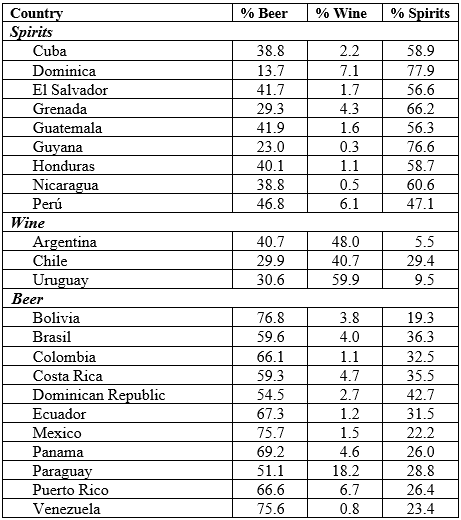
Table 1: Market Shares Based on Levels of
Alcohol Consumption, 2010 (15+ years)

Source: WHO (2014).
According to World Health Organization (WHO) (2014), Latin American countries are the most heterogeneous on the planet in terms of average preferences for liquor consumption (see also Pierce and Toxqui, 2014; Aizenman and Brooks, 2005). The Caribbean, for example, is recognized for its rum production, while Chile and Argentina are recognized wine producers. But no Latin American country is specifically recognized for its brewing traditions; nonetheless, from 2008 to 2013, beer was the most important alcoholic beverage in the region, with approximately 50% of total production in the alcoholic beverages market.
Analyzing alcohol consumption by country (see Table 1), beer is the most preferred alcoholic drink in 11 out of 23 countries (48%). Spirits are most preferred by 39% of countries, particularly in Central American markets, where populations are more traditionally inclined to the consumption and production of spirits such as tequila and sugarcane distillates such as aguardiente and, particularly, rum. In Chile, Uruguay, and Argentina (13%), wine is the most popular alcoholic drink (WHO, 2014).

Consolidation of the Beer Industry

At the end of the 20th century, 10 firms produced half of all beer worldwide; by 2012 the same share was divided among only four firms (Howard, 2013). This concentration will likely only increase after the merger between AB InBev and SABMiller announced in November 2015 (AB InBev, 2016). This strategic integration has generated a global conglomerate that controls approximately one-third of the global market. The trend toward worldwide concentration has been mainly driven by economies of scale and horizontal integration. In the case of Latin America, concentration levels are substantially higher, almost double, than in the rest of the world.
Worldwide in the last decade, the beer industry has witnessed intense changes in its market structure. After the mass-produced lager brewing industry, or macrobreweries, standardized its industrial processes and took advantage of economies of scale, craft breweries began popping up globally, revealing evidence of possible structural changes in market conditions.  
In 2013, 83% by volume of beer consumed in Latin America was produced by just four countries: Brazil (42%), Mexico (22%), Venezuela (11%), and Colombia (8%). With the arrival of multinational companies to the region over the last two decades, the war to conquer Latin American consumers has intensified. In most countries, the beer markets are duopolistic, dominated by big world players such as AB-InBev, SABMiller, and Heineken.
In 2010, Heineken purchased the brewery division of FEMSA, a firm with operations in several Central American countries. In 2011, Kirin Brewery Company, a Japanese firm, ought Brazilian Schincariol Brewery. In Mexico, AB InBev purchased Grupo Modelo in 2013. The arrival of the world goliaths in Latin America has consolidated the market for mass-produced American lager beer.
However, in spite of the apparently strong trend toward industry concentration and the production supremacy of American lager beers, consumers’ interest in new products is increasing. In relation to this shift toward new products, Howard (2013) states that “cultural barriers to global brands in emerging markets, and the rising consumer interest in varieties produced by smaller specialty brewers…” (p. 13) may increase opportunities for small players with differentiated products. Latin America is not an exception, and cultural barriers, income growth, and heterogeneity in consumer tastes may become barriers to the consolidation of a worldwide duopoly.
Traditionally, industries have been characterized as “consolidated” when large companies with high economies of scale make it harder for smaller companies to enter into the market due to cost advantages. The emergence of niche markets result, which is the case for craft beer (Carroll and Swaminathan, 2000; Swinnen and Garavaglia, 2017).

Craft Beer in Latin America

Although large-scale beer still dominates the Latin American market, a new picture is starting to emerge. The main source of recognition for the brewing industry in region is that Latin American beer may be described by three basic criteria (Webb and Beaumount, 2013): it is clear and bland, it is served cold, and it is produced by a big mass brewery, often a multinational company. These characteristics may have generated an opportunity for market development, in which the increase in the number of micro- and craft breweries follows the same structural market pattern witnessed in the North American and European brewing industries.  On average, small brewery market share in the region was 1.3% between 2008 and 2013. Meanwhile, the market share for small breweries in the rest of the world was considerably higher, 4.8% on average (Figure 1; Euromonitor, 2015).
Figure 1: Average Small Brewery Shares
by Region (2008–2013)


Source: Euromonitor (2015).
For this period, small craft breweries in some countries in Latin America experienced an important evolution in terms of market share compared to mass-produced beer. Argentina, Bolivia, Brazil, Chile, and Costa Rica are examples of countries where small craft breweries averaged more than 2% of the total market share (Euromonitor, 2015).
Despite the low market shares of the craft beer segment in the region, the growth rate has been substantially high: 6.6% a year on average between 2008 and 2013. This is more than twice the growth observed in the regional mass-produced beer segment for the same period (2.8%) and almost double the World Bank’s regional GDP growth figure (Euromonitor, 2015).

Craft Beer Industry Potential

The Latin American brewing industry is especially dynamic in terms of its rapid growth. Between 2008 and 2013, the sector grew twice as fast as the world beer market sector, an average of 2.8% versus 1.4% (Euromonitor, 2015).  As mentioned previously, Latin American market has reached its maturity due to the consolidation of the mass breweries, and the appearance of small craft breweries indicates a trend toward a more diversified market. In this sense, Latin America and the Caribbean are a battleground for large breweries and a nursery for craft breweries.
Interest in producing and consuming craft beer is recent in Latin America and is growing fast as a niche market, as has happened in other markets around the world. For example, Toro-Gonzalez, McCluskey, and Mittelhammer (2014) analyzed the case of U.S. beer consumption, finding that craft beer consumers are different from those who consume mass-produced and imported beer, with no evidence of substitution among products.
An indicator of the increasing popularity of craft beer is the number of searches reported by Google Trends for the term “craft beer” both in Spanish and Portuguese, Brazil’s national language. The number of searches grew by 3% on average every month from January 2010 to November 2016. Between 2012 and 2016, interest in the term grew by 317%. According to Google Trends, Brazil, Chile, Argentina, and Mexico (in that order) are most interested in craft beer among Latin American countries.
In terms of consumption and income, two elements support the initial claim of a sector with interesting opportunities. According to OECD (year), Latin America consumes almost half as much per capita annually (1.45 gallons) compared to the rest of the world (2.45 gallons). However, this gap seems to be closing; between 2008 and 2013 the total consumption in Latin America grew by 5.8% on average, while total world consumption grew by only 1%.
In terms of income growth, the income elasticity of demand for beer to be elastic in Latin America, where an increase in income of 1% will increase consumer demand for beer by 1.2%. This implies there is an important opportunity for growth in the brewing industry, especially for craft brewers, whose niche market is highly influenced by income level (citation, year). Income in Latin America is expanding at 3.8% yearly (citation, year). This is an important element to explain the 42% in total market growth over the last 20 years in the region. It is possible to infer that the market will expand in the near future, given the regional income growth trends (Toro-Gonzalez, 2015).
Based on the available evidence, is not difficult to see that the brewing industry—and specifically the craft brewing industry—has an important opportunity in the Latin American market.

For More Information

Aizenman, J., and E. Brooks. 2005. “Globalization and Taste Convergence: The Cases of Wine and Beer.” SCCIE Working Paper 05(05).
Carroll, G.R., and A. Swaminathan. 2000. “Why the Microbrewery Movement? Organizational Dynamics of Resource Partitioning in the U.S. Brewing Industry.” American Journal of Sociology 106(3):715–62.
Euromonitor. (2015). Euromonitor International Passport Dataset. Available online: http://go.euromonitor.com/passport.html
Howard, P.H. 2013. “Too Big to Ale? Globalization and Consolidation in the Beer Industry.” Working Paper, SSRN.
OECD. (2014). Consumption Tax Trends 2014. OECDiLibrary. Retrieved from OECDiLibrary: http://dx.doi.org/10.1787/ctt-2014-en
Pierce, G., and A. Toxqui. 2014. Alcohol in Latin America: A Social and Cultural History. Tucson, AZ: University of Arizona Press.
Swinnen, J., and C. Garavaglia. 2017. Economic Perspectives on Craft Beer: A Revolution in the Global Beer Industry. London: Palgrave Macmillan.
Toro-Gonzalez, D., J. J. McCluskey, and R.C. Mittelhammer. 2014. “Beer Snobs Do Exist: Estimation of Beer Demand by Type.” Journal of Agricultural and Resource Economics 39(2):1–14.
Toro-Gonzalez, D. 2015. “The Beer Industry in Latin America.” AAWE Working Paper No. 177.
Webb, T., and S. Beaumont. 2013. Atlas Mundial de la Cerveza. Barcelona: Blume.
World Bank data, last update July 21, 2017.
World Health Organization (WHO). 2014. Global Status Report on Alcohol and Health 2014. Geneva: World Health Organization. Available online: http://www.who.int/substance_abuse/publications/global_alcohol_report/en/

miércoles, 7 de octubre de 2015

A Thousand Kisses Deep - Cohen

Leonard Cohen

You came to me this morning and you handled me like meat.
You’d have to be a man to know how good that feels, how sweet.
My mirrored twin, my next of kin, I’d know you in my sleep and who but you would take me in, a thousand kisses deep.

I loved you when you opened like a lily to the heat, you see I’m just another snowman standing in the rain and sleet, who loved you with his frozen love, his second hand physique, with all he is, and all he was,
A thousand kisses deep.

I know you had to lie to me, I know you had to cheat, to pose all hot and high behind the veils of shear deceit, our perfect porn aristocrat so elegant and cheap, I’m old but I’m still into that,
A thousand kisses deep.

I’m good at love, I’m good at hate, it' s in between I freeze.
Been working out, but its too late, it’s been to late for years.
But you look good, you really do, they love you on the street.
If you were here I’d kneel for you,
a thousand kisses deep.

The autumn moved across your skin, got something in my eye, a light that doesn’t need to live, and doesn’t need to die.
A riddle in the book of love, obscure and obsolete, till witnessed here in time and blood,
A thousand kisses deep.

And I'm still working with the wine, still dancing cheek to cheek, the band is playing Auld Lang Syne, but the heart will not retreat.
I ran with Diz and I sang with Ray, I never had their sweep, but once or twice they let me play
A thousand kisses deep.

I loved you when you opened like a lily to the heat, you see, I'm just another snowman standing in the rain and sleet, who loved you with his frozen love, his second hand physique, with all he is, and all he was,
A thousand kisses deep.

But you don’t need to hear me now, and every word I speak, it counts against me anyhow,
A thousand kisses deep.

Here

jueves, 7 de mayo de 2015

The Beer Industry in Latin America

AAWE Working Paper No. 177 – Business

This document presents the current state of the brewing industry in Latin America with special attention given to micro brewing firms. We find that the market conditions in Latin America are favorable to significant growth in the brewing industry and particularly for craft and specialty beers. This study draws on a general overview of the industry in the region as well on five different countries. May 2015.  Document here.

jueves, 18 de septiembre de 2014

miércoles, 7 de mayo de 2014

Flipped Classroom in Cartagena-Colombia

Students talk about the Flipped Classroom strategy. The methodology was implemented during the spring semester 2014 by Daniel Toro Gonzalez PhD in the course "Introduction to Industrial Organization".


sábado, 6 de abril de 2013

Mind Over Money

Mind Over Money

Extraordinario documental de NOVA-PBS sobre los retos de la teoría económica para explicar la realidad con base en la racionalidad de los agentes y sobre los logros de la economía del comportamiento (Behavioral Economics) al respecto.

miércoles, 18 de enero de 2012

Are Micro and Macro Brews Substitutes?

Daniel Toro-Gonzalez, Jill J. McCluskey and Ron C. Mittelhammer

Although mass producers’ market share still represents more than 95% of sales, the trend of consumers switching from traditional to craft beer seems irreversible. How strong are the consumer’s preferences about this new type of beers? Given that brewing companies are subject to different policy regulations, especially taxes, the knowledge about consumer’s preferences is relevant to formulate more informed policy decisions to the industry. The aim of this paper is to estimate price, income and substitution elasticity of craft beers with respect to mass produced beers. We verify the hypothesis of that beer is a normal good with an inelastic demand with respect to prices and higher income elasticity for high end beers (craft +Import) compared to mass-produced beers. We also find that the elasticity of substitution between categories of beer is almost zero, which may imply no substitution between categories of beer because consumers do not return when they move their consumption from one type of beer to another.

See the ppt presentation of Jill McCluskey at the Beeronomics: The Economics of Beer and Brewing. November, 2011, University of California, Davis. Here

viernes, 5 de noviembre de 2010

Rename the Gossip

About the topic of time spend on Facebook posted two days ago (See post), Alcides, a friend of mine, point out that “although there are some high costs paid in a specific realm (productivity) the benefits in other areas might as well override those costs”. Specifically Alcides research is oriented to find “how SNS might benefit psychological well being, social capital, and community attachment”. This position is not far away from economic theory. The argument is that people are always looking for the maximum utility (happiness) they can get from allocating their resources, like time in this case. Thus, the estimate of $225 dollars per month based on the average of an hour and a half per person each day is just simply an indicative of the individual willingness to pay for being in touch with family and friends, in this sense, maybe is better to change the characterization of the phenomena from “social cost of gossip” for “social valuation of social networking”.
Notice that the figures provided are not giving any kind of information about when and where the time on Facebook was spent, home or work, day or night. This comment is just to rule out the possibility of link the use of social networking with changes in productivity, which is a different but interesting topic.

miércoles, 3 de noviembre de 2010

Social Costs of Gossip

Have you ever thought about the total amount of time people spend on Facebook?
I bet you have felt guilty because you spend too much time on Facebook, catching up with pictures and events. Well, don’t be too worried, because you are not alone. The use of Facebook has been growing exponentially, since its launch from a Harvard dorm room in February of 2004. The number of active users has increased by more than nine percent each month, since its creation through July of 2010, when more than 500 million people were registered as active users, each user with an average of 130 friends.
In terms of use, according to the statistics of the popular social networking website, people spend over 700 billion minutes per month on Facebook. Certainly this is a huge number, but how much is it in terms of one person? Well, it turns out that approximately half of the active users log on any given day, this means that on average each person spends an hour and a half (1 hour 30 min) on this social network every day. So are you contributing to the increase of that number? You don’t have to feel guilty if you come in under that number, are you?
In terms of the federal minimum wage, the time each person spends on this social network is equivalent to US$225 dollars a month or equivalently, believed or not, 7.19% of the U.S. total GDP in 2009. Is this the social cost of gossip?

Source: Facebook

jueves, 14 de octubre de 2010

Chimamanda Adichie: The danger of a single story

Chimamanda Ngozi Adichie, is a writer, or as she describes her self a 'story teller', who gives us a beautiful perspective about the role of knowledge in building a better society. This is excellent story. I hope you enjoy it.